Cabins · Expandable container house
Expandable container house.
Five sizes, 18.5 to 74 m².
A steel-framed unit that folds to container width for transport and opens out on site into a finished room. Five sizes from 18.5 to 74 m². The Small 20FT travels 700 mm wide and opens to 4800 mm, and six of them load into one 40HQ. The 40FT carries a bathroom and kitchen. Order quantity is confirmed against the selected format and shipment plan.
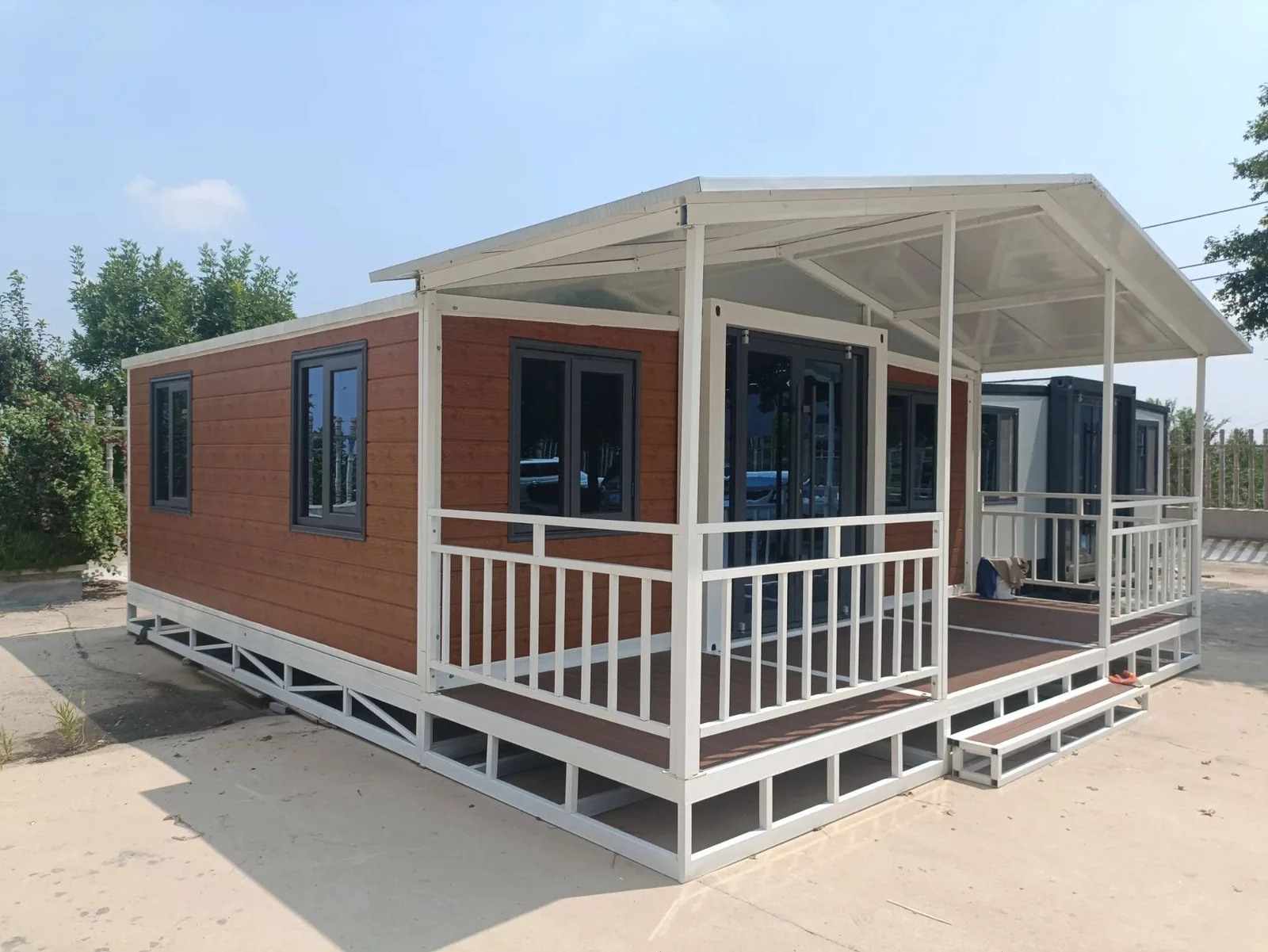
Expandable pod, expandable container home, double-wing house
The same format is sold under all of these names, and under “rapid deployment housing unit” when it is bought for workforce or relief accommodation. Nothing in the building changes with the label. What does change between offers is the footprint, the wall build-up, whether the unit carries its own wet area, and how many load into a container — so those are the four things worth comparing, whatever the listing calls it.
Five models, one decision
The five sizes are not smaller and larger versions of the same unit. They answer different loading and use questions, and the gap between them is wider in freight than in unit price. Pick by which cost you are trying to hold down.
| Model | Floor area | Per 40HQ | Floor area per 40HQ | What it buys you |
|---|---|---|---|---|
| Small 20FT · AP-E20S | 27.5 m² | 6 | 165 m² | The most floor area per container of the five |
| 10FT · 10FT expandable | 18.5 m² | 4 | 74 m² | A small footprint at four per box |
| 20FT · AP-E20 | 37 m² | 2 | 74 m² | A larger single room at two per box |
| 30FT · 30FT expandable | 57 m² | 1 | 57 m² | A large single unit |
| 40FT · 40FT expandable | 74 m² | 1 | 74 m² | A full dwelling with a bathroom and kitchen inside it |
Rows of 20FT units with a shared ablution block land cheaper per bed than the same headcount in 40FT units. A single 40FT unit on a rural block beats a 20FT unit plus the plumbing run to a separate wet area. Tell us the headcount and the site, and we will price the models that fit — including the cheaper one.
Dimensions
Figures are for the standard build. Dimensions, insulation and the electrical standard all change with the destination — the drawing set issued before production is the controlling document.
| Model | Transport (L × W × H) | Expanded (L × W × H) | Internal (L × W × H) |
|---|---|---|---|
| AP-E20S | 5900 × 700 × 2480 mm | 5900 × 4800 × 2480 mm | 5640 × 4640 × 2240 mm |
| AP-E20 | 5900 × 2200 × 2480 mm | 5900 × 6300 × 2480 mm | 5740 × 6140 × 2200 mm |
AP-E20 build specification
| Net weight | 2,500 kg |
|---|---|
| Wall and roof | Side wall 75 mm sandwich panel; partition and main and side roof 50 mm sandwich panel. Rock wool, EPS or polyurethane core. Thermal performance is calculated per specification on request. |
| Electrical | Built to the destination standard — 120/240V North America, 230V Europe and the UK, 240V Australia and New Zealand. Circuit and socket standards are matched to the destination. |
| Wet area | None on the 20FT. The 40FT carries a bathroom and kitchen. |
| Deployment | Small 20FT: crew, lifting equipment and deployment period are confirmed in the project installation method. Wall panels are installed from the central core during deployment. |
Wind and snow design values are issued per destination against the governing code, not quoted as a single global figure. Ask for them with your site location and we will state the basis.
What fits in a 40HQ
Freight is a real line on this order, and across our families it swings more than the unit price does. This is the comparison most buyers end up building in a spreadsheet, so it is on the page.
| Family | Units per 40HQ | Floor area per 40HQ |
|---|---|---|
| Folding container house — 14 m² room | 12 units, 10 for corrugated models | 168 m² |
| Expandable — Small 20FT (AP-E20S) | 6 units | 165 m² |
| Expandable — 10FT (10FT expandable) | 4 units | 74 m² |
| Expandable — 20FT (AP-E20) | 2 units | 74 m² |
| Expandable — 30FT (30FT expandable) | 1 unit | 57 m² |
| Expandable — 40FT expandable | 1 unit | 74 m² |
| Capsule house | Out of gauge — ships on a flat rack | — |
One row in that table is not a limitation of ours. A capsule house is 3000 to 3300 mm wide against roughly 2350 mm of internal width in a 40HQ, so no manufacturer's capsule house fits inside a standard container — the category ships as out-of-gauge cargo on a flat rack. We price that freight into the quotation rather than leave it on your freight invoice, and the over-dimensional status carries into the road leg at the destination.
Plan the unit, the shipment and the receiving site
These six buyer guides take the numbers above into the decisions that normally sit outside a product sheet. Use them to brief a developer, contractor, freight partner or local approval team on the same basis before asking factories to quote.
- Compare the AP-E20S and AP-E20 20FT models
- Review the self-contained 40FT expandable with bathroom and kitchen
- Compare all five sizes and the room each one produces
- Build a landed-cost comparison instead of comparing factory prices
- Release access, supports, lifting and utilities before dispatch
- Specify insulation, joints, moisture control and HVAC for the destination
- Compare expandable and folding units on one shipment and room brief
- Write a procurement brief for rapid-deployment accommodation
- Audit the factory and controls behind an expandable-house quotation
- Compare portable rooms by use, services and delivered scope
How this is quoted and ordered
Expandable container houses are supplied on a project basis. We quote one figure for the agreed scope rather than a priced parts list, and issue a written exclusions list alongside it so a single number is never ambiguous.
- Order quantity is confirmed per quotation.
- The factory programme is confirmed after drawing approval for the selected configuration and quantity.
- Payment amounts and release records are defined in the project quotation and contract.
- You, or an inspector you appoint, may attend the pre-dispatch inspection or inspect independently, at your cost.
- Warranty periods, included elements, exclusions and claim handling are defined in the project contract.
Freight, duties and the point at which risk passes are named in the contract. The full terms are set out on warranty and responsibilities, and the cost structure from factory gate to first guest is broken down in the landed-cost model.
What the site needs before the container arrives
| Offloading | A crane or forklift takes the unit off the container. Confirm the access route, hardstanding and swing area before the container sails. |
|---|---|
| Supports | Level, load-bearing support points prepared to the issued drawing. Ground conditions are assessed locally. |
| Utilities | Power, water and drainage brought to the prepared interfaces. The connection itself is local work. |
| Sealing and finishing | Final weather sealing at the joints once the unit is open and set. |
| Approvals | Obtained locally. We supply the technical documents that support them. |
Foundations, crane and lifting, utility connections, installation labour and local permits sit with the buyer. Engineering, manufacture, inspection, packing and the document set sit with us. The full split is published as a responsibility matrix.
Documents supplied with every order
- Drawing set issued for approval before production starts
- Bill of materials for the configuration you ordered
- Container loading plan
- Inspection report issued before dispatch
- Installation and deployment instructions
On engineered projects the document set goes further — a six-level bill of materials, a structural calculation book and a step-sequenced installation manual. See a live project.
Expandable container house questions
How many expandable container houses fit in a 40HQ?
Six Small 20FT units (AP-E20S), four 10FT units, two 20FT units, and one each of the 30FT and 40FT. In floor area that is 165 m² per container for the Small 20FT, 74 m² for the 10FT, 20FT and 40FT, and 57 m² for the 30FT.
What is an expandable container house?
A steel-framed unit that ships folded to container width and opens out on site into a finished room. The AP-E20S travels at 5900 × 700 × 2480 mm and opens to 5900 × 4800 × 2480 mm — 27.5 m² of internal floor area from a unit 700 mm wide in transit.
Which expandable model has a bathroom and kitchen?
The 40FT expandable carries a bathroom and kitchen inside the unit. The 20FT has no wet area, so rows of 20FT units are normally planned with a shared ablution block.
How long does an expandable container house take to deploy on site?
Crew size, equipment and deployment time are confirmed in the installation method for the selected configuration and receiving site. A crane or forklift is needed to offload, and wall panels are installed from the central core during deployment.
How are order quantity and the factory programme confirmed?
Order quantity and factory programme are confirmed for the selected configuration, approved drawing set and production schedule.
Is an expandable pod the same as an expandable container house?
Yes. The same format is sold as an expandable pod, an expandable container home and a double-wing expandable house, depending on who is writing the listing. What actually differs between offers is not the name but the footprint, the wall build-up, whether the unit carries its own wet area, and how many load into a container.
Can these be used for rapid-deployment housing?
That is one of the main uses. The unit ships folded to container width and opens on prepared supports. The project method still has to define offloading, crew and lifting equipment, level load-bearing supports, and power, water and drainage brought to the prepared interfaces.
Which size is cheapest per bed?
Usually rows of 20FT units with a shared ablution block, rather than the same headcount in 40FT units. The 30FT is the one to check twice: it carries 57 m² in a container the 40FT fills with 74 m², so its freight per square metre is the weakest of the five.
Send the site, the headcount and the room brief
We will come back with the models that fit, the loading per container for each and what the site has to have ready before it sails.
Open the procurement toolkitNo form, nothing to sign up for.