Cabins · Folding container house
Folding container house.
Twelve units per 40HQ.
Twelve 14 m² folding units load into one 40HQ — ten for corrugated models. That is 168 m² of finished floor area in a single container, and the lowest freight cost per unit in our range. On a multi-unit site it is the number that decides which family you order.
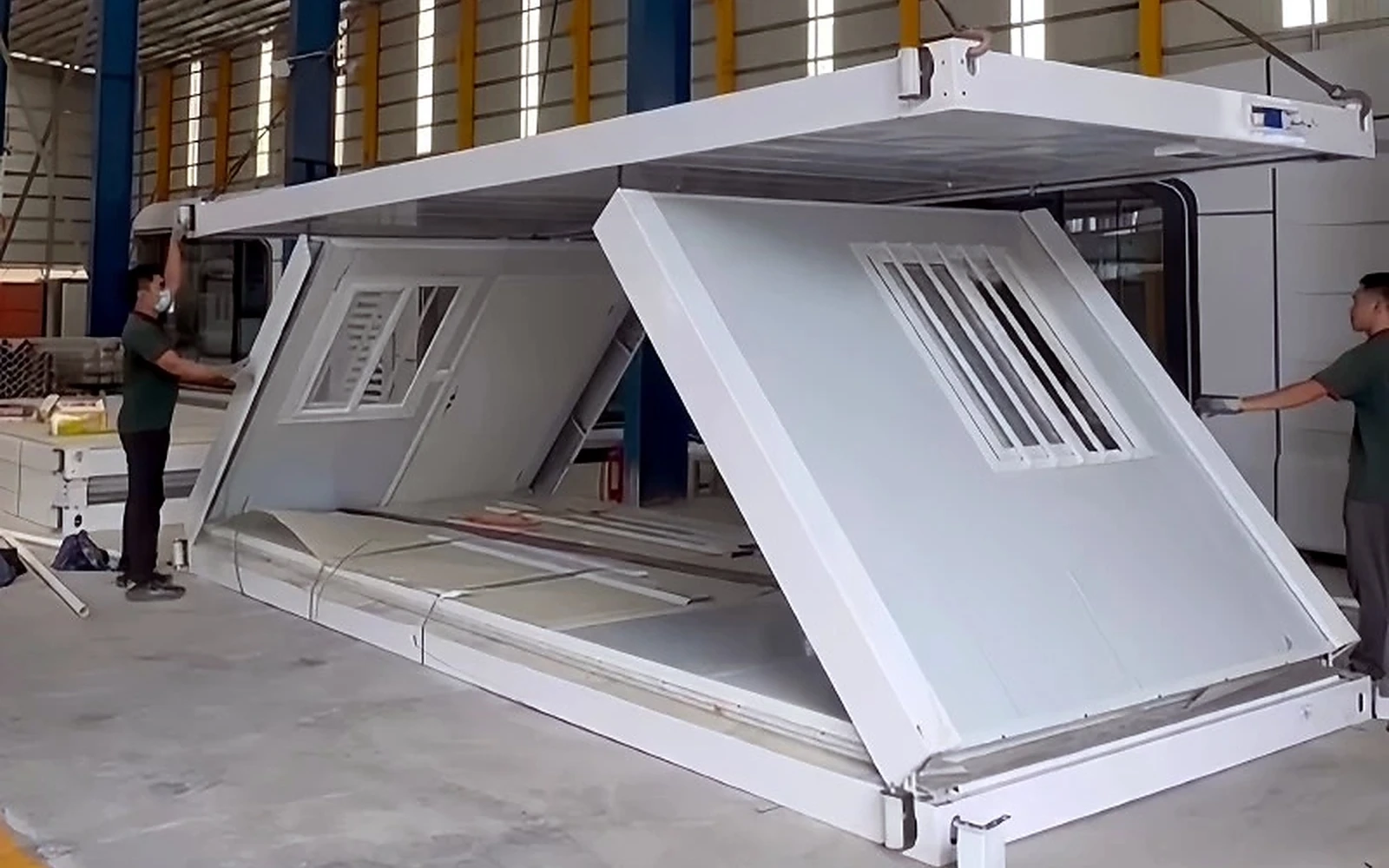
Folding or expandable
Both families ship compressed and open up on site. They split on how many units fit in the box and on what is inside each one when it opens.
| Folding — 14 m² room | Expandable | |
|---|---|---|
| Loading per 40HQ | 12 units; 10 corrugated | Small 20FT 6 · 10FT 4 · 20FT 2 · 30FT 1 · 40FT 1 |
| Building area | 14 m² | 18.5 · 27.5 · 37 · 57 · 74 m² |
| Floor area per 40HQ | 168 m² | Small 20FT 165 m² · 10FT 74 · 20FT 74 · 30FT 57 · 40FT 74 |
| What it buys you | Volume — the most units per container movement | Floor area per unit, and a wet area on the 40FT |
Twelve folding units and six Small 20FT expandable units land in the same container slot, so on a headcount-driven project the folding house wins on freight per bed. Where each unit needs its own bathroom and kitchen, the 40FT expandable is the shorter route. Tell us the headcount, the site and whether the amenities are shared, and we will price both families.
14 m² folding room specification
Figures are for the standard build. Dimensions, insulation and the electrical standard all change with the destination — the drawing set issued before production is the controlling document.
| Product reference | 14 m² folding room |
|---|---|
| Deployed dimensions (L × W × H) | 5800 × 2480 × 2500 mm |
| Building area | 14 m² |
| Net weight | Approx. 850 kg, ordinary models |
| Wall panel — ordinary | 50 mm rock wool sandwich panel, 0.15 mm steel sheet |
| Wall panel — corrugated | 65 mm rock wool sandwich panel, 0.45 mm steel sheet |
| Base configuration | Door, window, lighting and sockets included |
| Electrical standard | Built to the destination standard — 120/240V North America, 230V Europe and the UK, 240V Australia and New Zealand |
| Loading per 40HQ | 12 units; 10 units for corrugated models |
| Floor area per 40HQ | 168 m², ordinary models |
| Order quantity | Confirmed per quotation |
| Factory programme | Confirmed after drawing approval |
Wind and snow design values are set per destination against the governing code rather than quoted as one global figure. Send your site location and we will state the basis.
Why twelve per container is the number that matters
Across our product families, freight swings more than the unit price does. Twelve folding container houses load into one 40HQ; corrugated models load ten. Nothing else in our range comes close, and on a project measured in beds rather than in units, that gap decides the landed cost.
| Family | Units per 40HQ | Floor area per 40HQ |
|---|---|---|
| Folding container house — 14 m² room | 12 units, 10 for corrugated models | 168 m² |
| Expandable — Small 20FT (AP-E20S) | 6 units | 165 m² |
| Expandable — 10FT (10FT expandable) | 4 units | 74 m² |
| Expandable — 20FT (AP-E20) | 2 units | 74 m² |
| Expandable — 30FT (30FT expandable) | 1 unit | 57 m² |
| Expandable — 40FT expandable | 1 unit | 74 m² |
| Capsule house | Out of gauge — ships on a flat rack | — |
The one thing to price in before you quote your own customer: a single unit will ship, but it occupies a container that holds twelve, so per-unit freight runs far higher than on a full load. On a trial order we will usually suggest a fuller box or a mixed load with another family. The full cost structure from factory gate to first guest is broken down in the landed-cost model, and the container arithmetic behind it in container mathematics.
Put both formats on the same brief
Our detailed expandable versus folding container house guide compares room count, floor area, wet areas, site work and relocation — using the actual 40HQ loading figures for both families.
How this is quoted and ordered
Folding container houses are supplied on a project basis. We quote one figure for the agreed scope rather than a priced parts list, and issue a written exclusions list alongside it so a single number is never ambiguous.
- Order quantity is confirmed per quotation.
- The factory programme is confirmed after drawing approval for the selected configuration and quantity.
- Payment amounts and release records are defined in the project quotation and contract.
- You, or an inspector you appoint, may attend the pre-dispatch inspection or inspect independently, at your cost.
- Warranty periods, included elements, exclusions and claim handling are defined in the project contract.
Freight, duties and the point at which risk passes are named in the contract. The full terms are set out on warranty and responsibilities, and the cost structure from factory gate to first guest is broken down in the landed-cost model.
What the site needs before the container arrives
| Offloading | A crane or forklift takes the unit off the container. Confirm the access route, hardstanding and swing area before the container sails. |
|---|---|
| Supports | Level, load-bearing support points prepared to the issued drawing. Ground conditions are assessed locally. |
| Utilities | Power, water and drainage brought to the prepared interfaces. The connection itself is local work. |
| Sealing and finishing | Final weather sealing at the joints once the unit is open and set. |
| Approvals | Obtained locally. We supply the technical documents that support them. |
Foundations, crane and lifting, utility connections, installation labour and local permits sit with the buyer. Engineering, manufacture, inspection, packing and the document set sit with us. The full split is published as a responsibility matrix.
Documents supplied with every order
- Drawing set issued for approval before production starts
- Bill of materials for the configuration you ordered
- Container loading plan
- Inspection report issued before dispatch
- Installation and deployment instructions
On engineered projects the document set goes further — a six-level bill of materials, a structural calculation book and a step-sequenced installation manual. See a live project.
Folding container house questions
How many folding container houses fit in a 40HQ?
Twelve 14 m² folding units per 40HQ, or ten for corrugated models. That is 168 m² of finished floor area in a single container — the lowest freight cost per unit in our range.
What is a folding container house?
A steel-framed room that ships folded flat and is unfolded on site. The folding 14 m² room measures 5800 × 2480 × 2500 mm deployed, gives 14 m² of building area and weighs about 850 kg in the ordinary build.
Folding or expandable — which should I order?
Folding buys volume: twelve units in the container slot that takes six Small 20FT expandable units, so on a headcount-driven project it wins on freight per bed. Expandable buys floor area per unit, and the 40FT carries a bathroom and kitchen. Tell us the headcount, the site and whether amenities are shared, and we will price both.
What is included in the base folding unit?
Door, window, lighting and sockets. The electrical build follows the destination standard — 120/240V North America, 230V Europe and the UK, 240V Australia and New Zealand.
What insulation do the panels use?
Ordinary models use a 50 mm rock wool sandwich panel with 0.15 mm steel sheet. Corrugated models use 65 mm rock wool with 0.45 mm steel sheet. Thermal performance is calculated per specification on request.
Can I order a single folding unit?
Order quantity is confirmed against the configuration and shipment plan. A partial container carries a very different freight cost per room from a full load, so a trial order and the intended programme load should be compared separately.
Tell us the headcount and we will price both families
Folding against expandable is a freight decision before it is a product decision. Send the site, the headcount and whether amenities are shared.
Open the procurement toolkitNo form, nothing to sign up for.